Faux Grass Calculators and Estimators (2026): Turf, Rolls, Seams, Base and Infill in One Place
Enter your yard's length and width once, and these calculators work out turf, seams, base, infill and nails.
Turf estimators turn your yard's dimensions into material quantities using simple formulas that installers use. One set of inputs gives you the turf to order, the seam length, the base rock, the infill and the fixings. That's what you need to build a shopping list or check a quote. For costs, use our cost calculator.
The formulas follow common installer practice, summarised by Constructly. Always check them against your turf maker's guidance, because rates vary by product.
Faux grass material estimator
Rates are typical starting points. Check them against your turf maker’s guidance.
Default notes: the base formula (÷ 324) and infill rate of 1 to 2 lb per sq ft follow common installer guidance, as summarised by Constructly. The tons-per-cubic-yard default of 1.4 is a typical figure for crushed rock; ask your supplier for theirs. Nail spacing defaults follow the ranges in our nails guide.
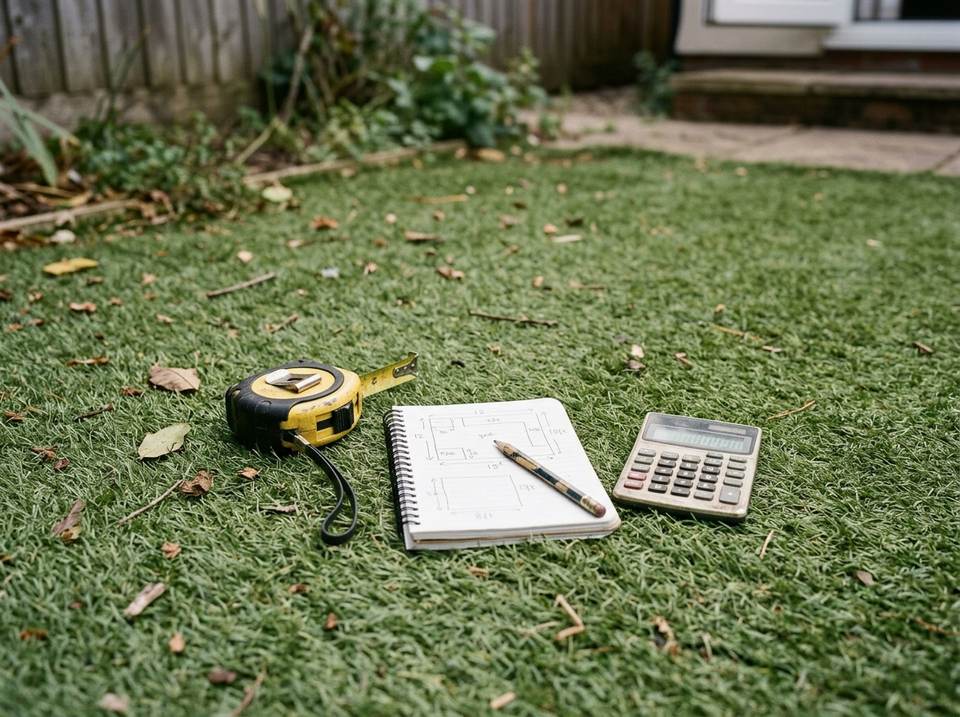
How do the formulas work?
Each estimate uses a simple formula installers use. Here they are:
- Turf and rolls. Strips needed = yard width ÷ roll width, rounded up. Linear feet = strips × yard length. Turf to order = strips × roll width × length, plus a 5 to 15% waste factor for shape. See our roll guide.
- Seams. Seam length = (strips − 1) × yard length. Seam tape rolls = seam length ÷ tape roll length, rounded up. The same area can need very different seams depending on shape, as the example below shows. See our seam tape guide.
- Base. Cubic yards = area (sq ft) × depth (in) ÷ 324. The 324 converts square feet and inches into cubic yards. Round up. For tons, multiply by your supplier's weight per cubic yard. See our base guide.
- Infill. Pounds = area × rate per sq ft. Typical lawns use about 1 to 2 lb per sq ft; putting and chipping turf use more. Bags = pounds ÷ bag size, rounded up. See our infill guide.
- Nails and pins. Count = perimeter ÷ edge spacing + seam length ÷ seam spacing + a field grid if your turf maker calls for one. See our nails guide.
Always round up to whole bags, rolls and tons. It's cheaper to have a little left over than to stop mid-job.
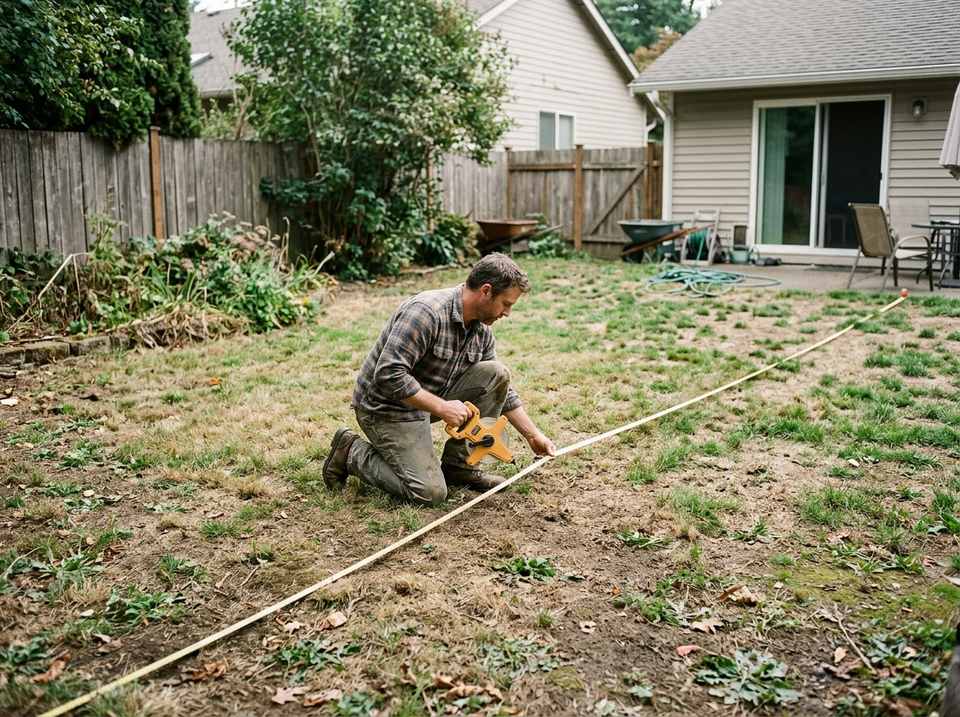
Worked example: a 20 × 25 ft yard
Here's every estimate for one typical backyard.
| Estimate | 20 × 25 ft yard (500 sq ft) | Working |
|---|---|---|
| Strips with 15 ft rolls | 2 strips, each 25 ft long | 20 ÷ 15 = 1.3, rounded up to 2 |
| Turf to order | 750 sq ft before waste | 2 × 15 ft × 25 ft |
| Seams | 1 seam, 25 ft long | (2 − 1) × 25 ft |
| Seam tape | 1 roll of 33 ft tape | 25 ÷ 33, rounded up |
| Base at 3 in deep | About 4.6 cubic yards | 500 × 3 ÷ 324 |
| Infill at 1.5 lb per sq ft | 750 lb, or 15 bags of 50 lb | 500 × 1.5 |
| Edge nails every 10 in | About 108 | 90 ft perimeter ÷ 0.83 ft |
| Seam nails every 8 in | About 38 | 25 ft ÷ 0.67 ft |
With 12 ft rolls instead, you'd still need 2 strips and 1 seam, but you'd order 600 sq ft, not 750, because the strips are narrower. That's why roll width matters. See 12 ft wide faux grass and 15 ft wide faux grass.
Now compare a 10 × 50 ft yard. It's the same 500 sq ft, but a single 12 ft strip covers the width, so there's no seam at all. The perimeter is longer, though, at 120 ft, so you'd need more edge nails, about 144. Same area, different job.
What the calculators can't tell you
Calculators give quantities; your site decides the extras. They can't account for:
- Slopes. Sloped yards may need more base, more fixings and a different layout. See faux grass for uneven ground.
- Irregular shapes. Curves and corners add waste beyond the waste factor.
- Clay soils. Poor drainage can mean a deeper base.
- Drainage fixes. French drains and regrading aren't included.
- Local prices. For costs, use our cost calculator and get local quotes.
Our take: from our hands-on work laying artificial grass for event stages and backdrops, the seam count matters more than the square footage. Every strip has to run with the pile facing the same way, or the join shows as a colour change, so plan your layout before you trust the turf number, and order a little extra rather than piecing in leftovers.