The Best Base for Faux Grass (2026): Materials, Depth and Compaction Explained
As an Amazon Associate we earn from qualifying purchases.
A faux lawn is only as flat and long-lasting as its base, and most failures trace back to a base that was too thin or not compacted.
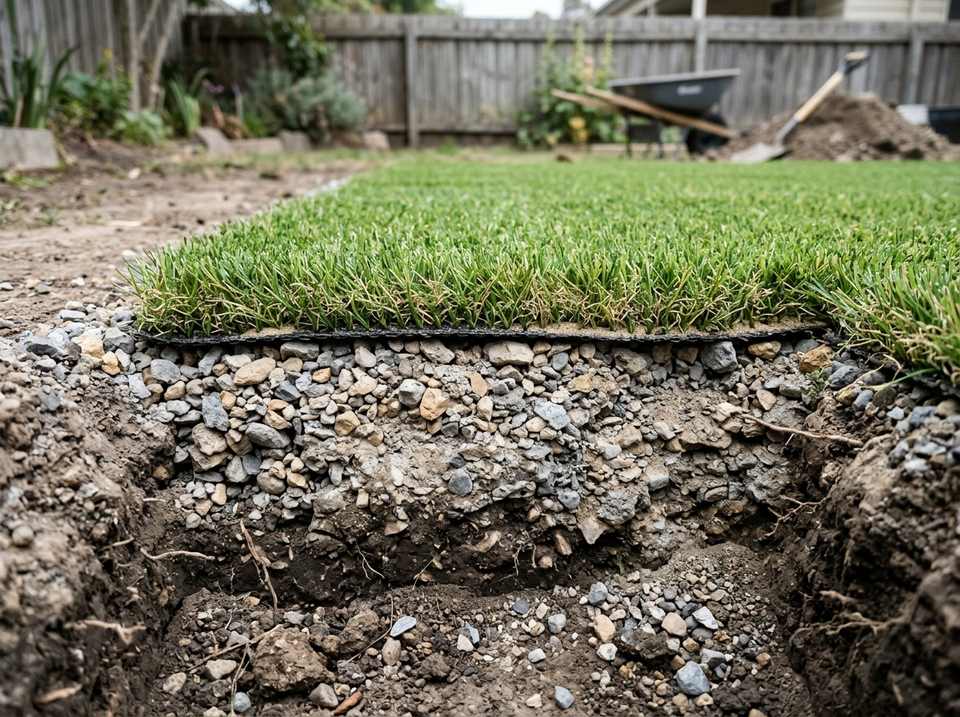
The base is the compacted layer of crushed rock and fine aggregate between the native soil and the turf. It does two jobs. It keeps the lawn flat and firm, so it doesn't dip under feet and furniture. And it drains water, so rain and pet urine pass down instead of pooling. Turf is just a surface. The base decides how that surface behaves for the next 10 or 15 years.
This guide explains the standard base recipe, how deep to go, which materials suit your climate and how to compact it. Our sources don't agree on every number, so we explain where they differ. Always follow your turf maker's spec if it gives one.
What is the best base for faux grass?
Most installers use two layers: drainage rock below, fine aggregate on top.
┌─────────────────────────────────────┐
│ Turf and infill                     │
├─────────────────────────────────────┤
│ Top layer: 1–1.5 in decomposed      │
│ granite or class II road base       │  ← smooth, compacted surface
├─────────────────────────────────────┤
│ Bottom layer: 2–2.5 in drain rock   │  ← lets water drain away
├─────────────────────────────────────┤
│ Optional weed barrier               │
├─────────────────────────────────────┤
│ Native soil                         │
└─────────────────────────────────────┘
That recipe comes from a Turf and Ivy installation guide: 2 to 2.5 in of compacted drain rock, then 1 to 1.5 in of decomposed granite (DG) or class II road base. The bottom layer is coarse, so water drains through it quickly. The top layer is fine, so it compacts into a smooth, tight surface for the turf to lie on.
| Layer | Material | Depth | Job |
|---|---|---|---|
| Bottom | Drain rock or crushed stone | 2 to 2.5 in | Drainage and strength |
| Top | Decomposed granite or class II road base | 1 to 1.5 in | Smooth, firm surface |
| UK equivalent | MOT Type 1, then granite dust or sharp sand | 75 to 100 mm, then 15 to 25 mm | Same roles |
What is the best base material for artificial turf? For most yards, crushed rock below and decomposed granite or road base on top. Crushed rock gives strength and drainage. DG gives a smooth finish.
Decomposed granite or crushed rock? Ideally both, in layers. Here the sources disagree a little. DG compacts and interlocks well, which is why it's popular as a top layer. But CCGrass notes that DG drains less than crushed stone. So if drainage matters most, for dogs or heavy rain, keep the DG layer thin and the rock layer thicker. See faux grass for drainage.
How deep should the base be?
Three to four inches covers most backyards.
| Use | Typical total base depth | Source |
|---|---|---|
| Residential lawn | 3 to 4 in | RealTurf |
| Lighter-use lawn (lower end) | 2 to 3 in | CCGrass |
| UK residential lawn | 75 to 100 mm, plus 15 to 25 mm laying course | MyBuilder |
| Heavy dog use or poor drainage | Toward the deeper end, with more drain rock | Installer guidance |
| Driveways and vehicle areas | 100 to 150 mm or more | UK guidance |
How deep should the base be for artificial grass? Most homes need 3 to 4 in of compacted base. Sandy, free-draining soil can work with less. Clay and wet sites need more.
Do pets or driveways need a deeper base? Pets need a base that drains well, so add drain rock rather than more DG. Driveways need a much deeper, stronger base to carry vehicles, and are best left to a professional.
You may see a claim that ASTM standards require a 10 in base for commercial turf. We couldn't verify that against an ASTM document, so we don't recommend relying on it. Commercial and sports fields do often use deeper bases, but the depth comes from the project's engineering spec.
Which base material suits your climate?
Wet climates need more drainage rock; dry ones can lean on decomposed granite. Here's how climate changes the recipe:
- Dry regions. Decomposed granite works well, because drainage is rarely the problem. RealTurf recommends DG for dry regions. It compacts into a firm, smooth surface.
- Wet regions. RealTurf suggests limestone chat, a fine crushed limestone, for wet regions. Add more drain rock underneath, and keep the fine top layer thin.
- Clay soil. Clay barely drains. Dig deeper and use a thicker layer of drain rock, so water has somewhere to go. On heavy clay, some installers add a drain pipe to carry water away.
- Freezing winters. A deep, well-compacted base resists frost heave, where frozen soil lifts the surface. See faux grass for snow.
- Heavy rain. Prioritise drain rock and slope. See faux grass for heavy rain.
What base is best for clay soil? A deeper base with more drain rock, and sometimes a drainage pipe.
For dry climates? Decomposed granite over a thinner rock layer.
How do you compact the base?
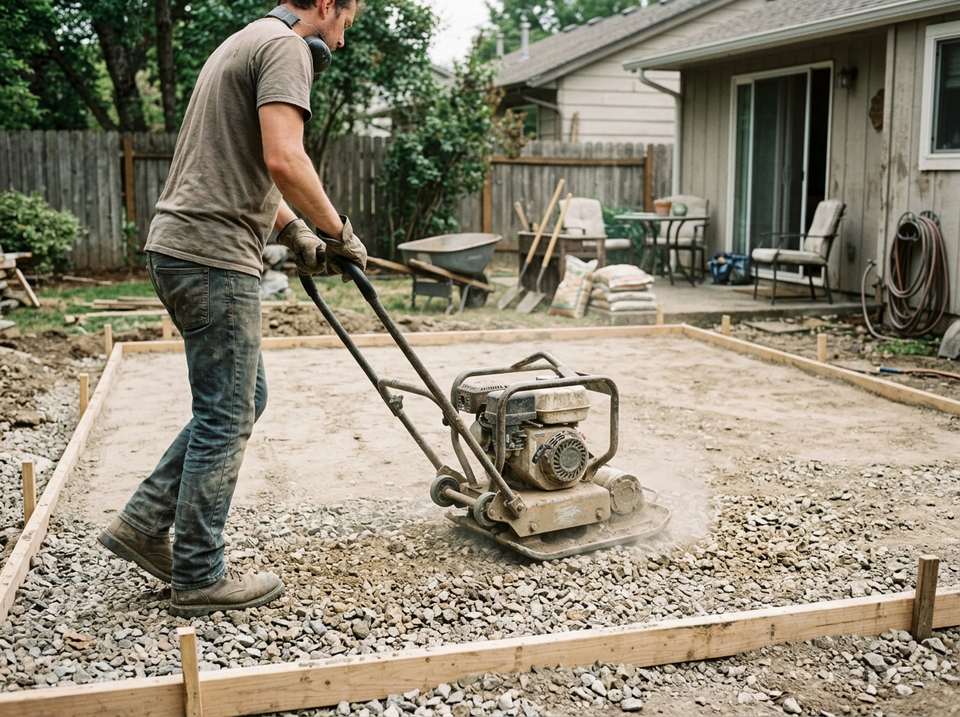
Compact in thin layers; one thick layer never compacts all the way down. Here's how:
- Prepare the soil. Dig out to depth, remove roots and stones, and roughly level the soil. Compact the soil itself first.
- Lay a weed barrier (optional). On weedy ground, lay a permeable barrier over the soil. See our weed barrier guide.
- Spread the first lift. Spread about 1 to 2 in of drain rock. Don't dump the full depth at once.
- Dampen lightly. Mist the layer with water. Slightly damp aggregate compacts better than dry, but don't soak it.
- Compact. Run a plate compactor over the layer in overlapping passes, several times. See our plate compactor guide.
- Repeat. Add the next lift, dampen and compact again, until the rock layer is at depth.
- Add the top layer. Spread the DG or road base, dampen and compact it the same way.
- Check level and slope. Use a string line and level. Aim for a gentle fall away from the house, around 1 to 2%. NexGen Lawns suggests up to 2 to 3%. Fill low spots and re-compact.
- Do a final smooth pass. Screed or rake the surface flat, then compact once more.
Do you need a plate compactor? For any lawn bigger than a small patch, yes. A hand tamper can't reach the same density. Plate compactors are cheap to rent for a day.
How do you know it's compacted enough? Walk on it. A properly compacted base barely shows a footprint.
Our take: from our hands-on work laying artificial grass for stages and events, every dip in the base shows through the turf as a shadow once light hits it from the side. Time spent compacting is the cheapest way to make turf look real.
Base supplies checklist
Most base materials come from a local landscape yard; the tools can be rented. Here's the list:
- Drain rock or crushed stone. From a landscape supply yard, delivered in bulk.
- Decomposed granite or class II road base. Also from a landscape yard.
- Weed barrier (optional). LAVEVE sells landscape fabric rolls on Amazon. Check price on Amazon
- Plate compactor. Rent from a tool hire shop. See our plate compactor guide.
- Landscape rake. For spreading and levelling aggregate.
- String line, stakes and level. For checking slope.
- Wheelbarrow and shovels. For moving aggregate.
- Garden hose with a mist nozzle. For dampening each layer.
Aggregate is heavy and cheap per ton, so local delivery is almost always better value than bagged products. For the full job, see our installation guide.
Base questions
These are the base questions DIYers ask most.
Can you use sand as a base? Not on its own. CCGrass warns that fine sand and loose soil trap moisture and sink, so the lawn ends up lumpy and soggy. Sharp sand can be a thin top layer in some UK installs, but only over a compacted stone base.
Can you skip the base? You can, but you'll likely regret it. Turf laid on bare soil develops dips, ripples and weeds, and drains poorly. If you're working with bare dirt, see faux grass for dirt.
Ready to lay the turf? See the full faux grass installation guide.