Realistic Faux Grass (2026): What It Is, What It Costs and 5 Turf Lines That Pass for Real
As an Amazon Associate we earn from qualifying purchases.
Realistic faux grass is a premium tier, and the extra cost buys density, colour depth and a thatch layer.
Realistic faux grass is landscape turf built to imitate a living lawn. It uses several shades of green, a brown or tan thatch layer at the base, matte fibres that don't shine, varied blade shapes and a higher density. Each of those costs more to make. Together, they're the difference between turf that looks like a lawn from the street and turf that looks like a doormat.
This guide covers the features, why realistic turf costs more, how to test realism with a sample, and five lines that come closest to real grass. We drew on guidance from RealTurf, ForeverLawn and UK retailer More For Your Floor, plus seller-listed specs on Amazon. Brand "most realistic" claims are marketing, which is exactly why the sample test matters. For visual traits in depth, see faux grass for a natural look. For full-lawn picks by grass type, see faux grass for a realistic lawn.
Why does realistic turf cost more?
More material and more colours mean a higher price per square foot. Here's where the extra goes:
- Higher density. More blades per square foot, so the lawn looks full and the backing never shows.
- More weight. More yarn means a heavier face weight. UK retailer More For Your Floor notes that realism costs more because of density, weight and pile.
- A taller pile. RealTurf puts realistic lawn turf at about 30 to 45 mm. Taller blades use more yarn.
- More yarn colours. Blending three or four greens costs more than one.
- Thatch yarn. RealTurf highlights brown thatch yarn as a key realism feature. It's an extra yarn added at the base.
Is realistic artificial grass more expensive? Yes, usually. You're paying for more material and more complex manufacturing. See our faux grass cost guide and premium faux grass.
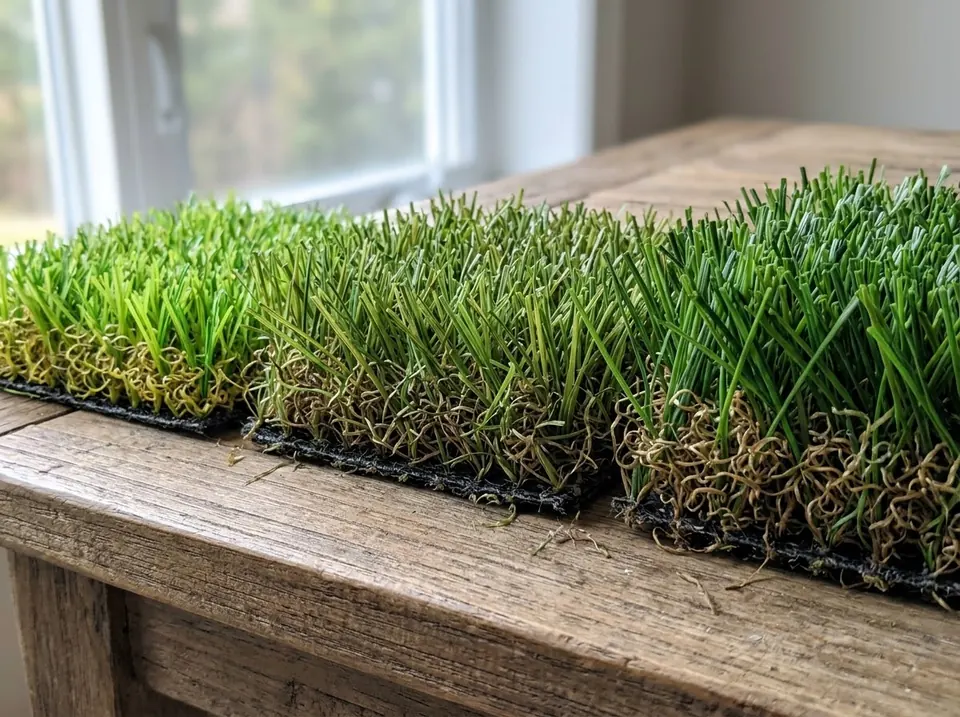
How do you check realism before buying?
A sample viewed outdoors in daylight tells you more than any product photo. Here's how to test one:
- Order samples. Get two or three samples from different brands, so you can compare.
- Take them outside. Indoor light hides shine and flattens colour. Look in daylight.
- Look from 6 to 10 ft away. That's how most people see your lawn. Does it read as grass, or as a green rug?
- Look up close. Check for a mix of greens and a brown or tan thatch layer at the base.
- Check for shine. Tilt the sample in the sun. Realistic turf is matte. Shiny blades look plastic.
- Compare with your neighbours' lawns. Hold the sample near real grass in your street. ForeverLawn stresses the colour blend; it should match the grass around you.
- Turn it around. Look at it from both directions. Pile direction changes the shade, so check it from where you'll usually see it.
- Do a bend test. Press the blades flat with your hand, let go and watch. Good turf springs back quickly.
How can you tell if artificial grass looks real? Look for several greens, a thatch layer, matte blades and quick bounce-back, and judge it outdoors, from a distance.
The 5 most realistic faux grass picks
These five lines come closest to living grass.
1. Goasis Lawn 1.38 in — Most Realistic Amazon Turf
Pile: 1.38 in | Colour: 4-tone with thatch | Claims: UV protection, fire resistant (seller-listed)
Goasis ticks the main realism boxes in one product: tall pile, four tones and thatch.
Goasis mixes four shades of green with a thatch layer at the base, at a 1.38 in pile that sits inside RealTurf's 30 to 45 mm realistic range. The thatch copies the dead grass at the base of real lawns, which is what stops turf looking like one flat colour. It comes in well over a thousand sizes, from 1 ft strips up.
But thatch traps more dirt than a plain pile, so rinse and brush it now and then.
Our take: from building backdrops with artificial grass, four greens plus a tan thatch is the combination that survives a close-up photo; turf without thatch looks fine from the street but flat and uniform once a camera gets near.
Check price on Amazon · Read our Goasis review
2. SunVilla 1.38 in — Best Realistic Turf That Holds Its Colour
Pile: 1-3/8 in | Colour: 4-tone | UV: resistant, colourfast (seller-listed) | Warranty: 10 years (seller-listed)
Realism fades with the colour. SunVilla's focus on colourfastness keeps it looking real for longer.
SunVilla lists colourfast, UV-resistant yarn in four tones, with a 10-year warranty claim. Garden Gate magazine named it its top grass rug.
That colourfast focus matters, because faded turf is the quickest way to look fake.
But it has no listed thatch layer, so it's slightly less realistic up close than #1.
Our take: in our experience with outdoor décor, fading is what gives faux grass away first; a lawn that keeps its green will pass for real long after a denser turf has gone pale in the sun.
Check price on Amazon · Read our SunVilla review
3. LITA Realistic Deluxe 0.8 in — Best Realistic Short Lawn
Pile: 0.8 in | Fiber: UV-resistant PE + PP | Colour: 4-tone with thatch
Not every real lawn is long. A freshly mown lawn is short, and LITA copies that.
LITA's 0.8 in pile is shorter than most realistic turf, but four tones and thatch keep it looking natural. It reads as a neatly mown lawn rather than a long, lush one. Shorter pile also stays upright more easily, so it keeps looking real with less brushing.
But at 0.8 in, it's below RealTurf's 30 to 45 mm realism range. For a lush lawn look, choose #1.
Our take: from our hands-on work with artificial grass, short pile is underrated for realism; it stays upright and even, while taller turf that's been walked flat looks fake faster than any short lawn.
Check price on Amazon · Read our LITA review
4. Premium Dealer Turf (SYNLawn, TigerTurf and Others) — Best Realism Overall
Sold by: dealers and installers (non-affiliate) | Typical features: multiple blade shapes, several greens, thatch, long warranties
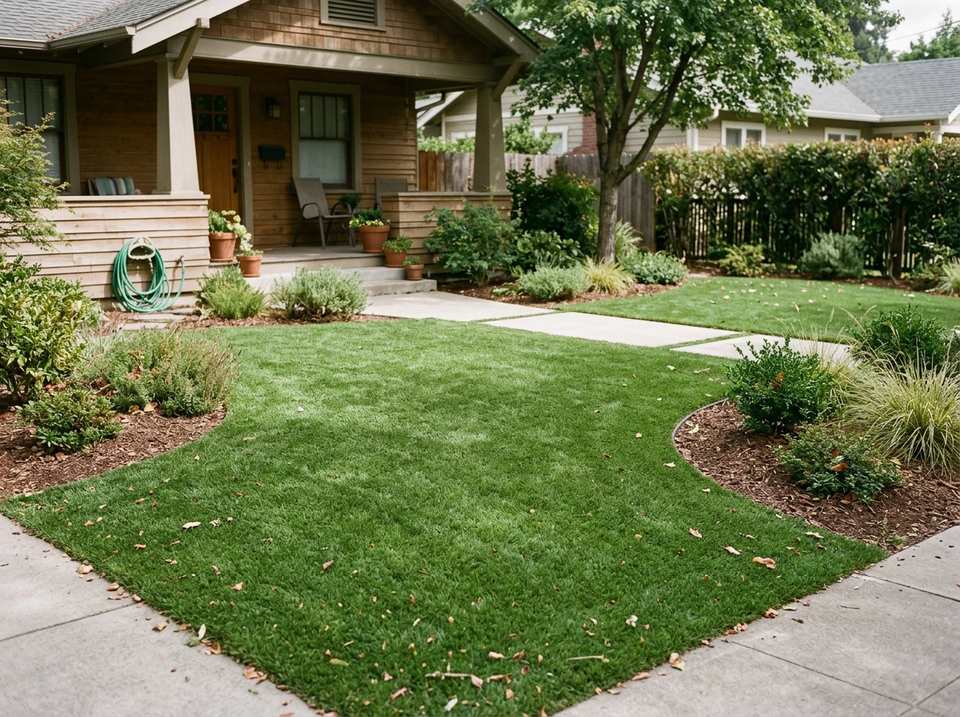
The most realistic turf usually isn't on Amazon. It's sold through dealers.
Premium brands such as SYNLawn and TigerTurf sell landscape lines named after real grass types, with several blade shapes, multiple greens and thatch. They're usually installed by a pro and come with longer warranties than online brands. Because you buy through a local dealer, you can usually see full-size samples and finished lawns before deciding.
But they cost more, and pricing comes through quotes. See our SYNLawn review and TigerTurf review.
Our take: from handling a lot of artificial grass, mixed blade shapes are what make premium turf look alive in moving light; single-shape blades reflect light evenly and give the game away.
5. Petgrow Deluxe 1.38 in — Best Value Realistic Turf
Pile: 1.38 in | Face weight: 70 oz (seller-listed) | Backing: rubber with drain holes
Want a realistic look on a tighter budget? Density is the spec to keep.
Petgrow's Deluxe line lists a dense 70 oz face weight at 1.38 in. Density is what makes a lawn look full and keeps the backing hidden, which goes a long way toward realism.
But check the listing for colour tones and thatch before buying, as it doesn't lead with them the way #1 does.
Our take: in our experience handling artificial grass, a dense face weight is what hides the backing when you look down at your feet, which is where cheap turf usually looks least real.
Check price on Amazon · Read our Petgrow review
Realism questions
These are the realism questions buyers ask most.
Does realistic turf stay realistic? It does if you protect it from fading and flattening. Choose UV-stable turf, brush it regularly against the grain and top up infill. See our maintenance schedule.
Does infill help realism? Yes. Sand infill fills the base of the pile, hides the backing and props blades upright, so the lawn looks fuller. See our infill guide.
For choosing colours, see our faux grass colours guide.