5 Best Faux Grass Picks for Under Trampolines (2026): Turf and Shock Pads That End the Dead Patch
As an Amazon Associate we earn from qualifying purchases.
Grass under a trampoline dies from shade and pressure; faux grass solves both and stays green year-round.
Every trampoline owner knows the circle. Move the trampoline in autumn and there it is: a perfect ring of yellow, dead grass, plus four dents from the legs. By next summer it's mud, and the kids track it into the house after every bounce session.
Fortunately, turf fixes the circle for good. But trampolines bring one safety question a normal lawn doesn't, which is what kids land on when they come off. So this page covers both. We compared seller-listed specs on Amazon and read guidance from trampoline makers Springfree, Berg and Acon. Always follow your trampoline maker's own surfacing guidance.
For climbing frames and swing sets, see faux grass for playgrounds and playground safety.
Quick picks: the best faux grass for under trampolines
| Best for | Pick | The spec that decides it |
|---|---|---|
| Best overall | PICK FOR LIFE 12 × 12 ft | 144 sq ft, cuts with scissors into a circle |
| Large trampolines | SunVilla 1.38 in | Sold in sizes up to about 325 sq ft (Garden Gate) |
| Landing ring | Turf over a foam shock pad | Pad under the area around the frame |
| In-ground trampolines | Petgrow Deluxe + pad | Dense 70 oz turf (seller-listed) for the surround |
| Best budget | VEVOR 12 × 7 ft, two pieces | Two pieces make a 12 × 14 ft square |
Why does grass die under a trampoline?
A trampoline shades the same circle of lawn all summer, and that patch can't recover.
Grass needs sun, and a trampoline mat blocks most of it. Springfree, a trampoline maker, explains that this shading is what kills the grass underneath. The frame and legs also press into the soil in the same spots, and kids running round the edge wear a track.
Interestingly, Springfree also says grass is the best surface to put a trampoline on, because it's softer than hard ground. Turf keeps that softer, green surface without the dying circle. Berg, another trampoline brand, suggests talking to a landscaper for the best surface in your yard.
What should go under a trampoline?
Use a pad where children land around the frame, and plain turf under the jumping mat.
| Area | What to put down | Why |
|---|---|---|
| Directly under the jumping mat | Plain turf, no padding needed | Nobody lands there. It just needs to stay green and clean. |
| The ring around the frame | Turf over an impact-absorbing pad | Berg recommends turf with an impact-absorbing base where children may fall off. |
| Under the legs | Level, firm ground | Keeps the frame stable. |
Two cautions. First, Acon, another trampoline maker, warns against putting anything under a trampoline that reduces the clearance under the mat. Keep turf flat and keep toys, furniture and raised edges out from underneath. Second, the ground must be level, so the frame doesn't rock.
In that setup, a shock pad is a foam layer that absorbs impact. See our shock pad guide.
What size turf do you need?
Cover the trampoline's footprint, plus a margin around it for landings. A margin of about 3 ft on every side is a common rule of thumb. Check your trampoline maker's guidance, since some recommend more.
| Trampoline diameter | Turf circle with ~3 ft margin | Square piece to cut from |
|---|---|---|
| 8 ft | About 14 ft | 14 × 14 ft |
| 10 ft | About 16 ft | 16 × 16 ft |
| 12 ft | About 18 ft | 18 × 18 ft |
| 14 ft | About 20 ft | 20 × 20 ft |
| 15 ft | About 21 ft | 21 × 21 ft |
If that's more turf than you want, cover just the trampoline's footprint for the dead patch, and use pads and mats for the landing ring.
The 5 best faux grass picks for under trampolines
These five picks fit standard round trampoline sizes.
1. PICK FOR LIFE 12 × 12 ft — Best Faux Grass for Under a Trampoline Overall
Size: 12 × 12 ft (144 sq ft) | Fiber: polypropylene | Backing: drain holes | Cut: with scissors
Most trampolines are round, and nobody sells round turf in the right sizes. So buy a big square and cut the circle.
PICK FOR LIFE's 12 × 12 ft piece covers the footprint of a 10 ft trampoline with a small margin, or the full footprint of a 12 ft one. The seller says it cuts with ordinary scissors, which makes cutting a circle easy. Tie a string to a stake in the middle and walk a marker round. Drain holes let rain run through, so the area under the mat doesn't stay muddy.
But it's polypropylene, so it's firmer than PE turf. That's fine under the mat, where nobody lands. Around the frame, add a pad.
Skip it if your trampoline is 14 ft or larger. Go to #2.
Our take: from cutting a lot of turf to shape, a single square piece is far easier to turn into a clean circle than joined offcuts; mark the line on the backing and cut from the back so you don't trim the blades.
2. SunVilla 1.38 in — Best Faux Grass for Large Trampolines
Pile: 1-3/8 in | Colour: 4-tone | Sizes: about 13 to 325 sq ft (per Garden Gate)
A 14 or 15 ft trampoline with a landing margin needs a lot of turf. SunVilla comes in sizes big enough.
Garden Gate magazine notes SunVilla sells sizes from about 13 to 325 sq ft. The top end covers a large circle with room to spare, so you can turf a big trampoline area without a seam across the middle. The 1-3/8 in pile is soft to land on, and four tones look like a real lawn.
But taller pile can flatten in the ring kids run round. Brush it monthly. The linked listing is a small 28 × 40 in size, so choose your size on the listing.
Skip it if you only need to cover a small dead patch. Go to #1 or #5.
Our take: in our experience, multi-tone turf with a taller pile is what reads as real lawn from a distance, which matters for a big circle that sits in the middle of the yard.
Check price on Amazon · Read our SunVilla review
3. Turf Over a Foam Shock Pad — Best Setup for the Landing Ring
Setup: foam shock pad under the turf ring around the frame | Source: Berg trampoline surfacing advice
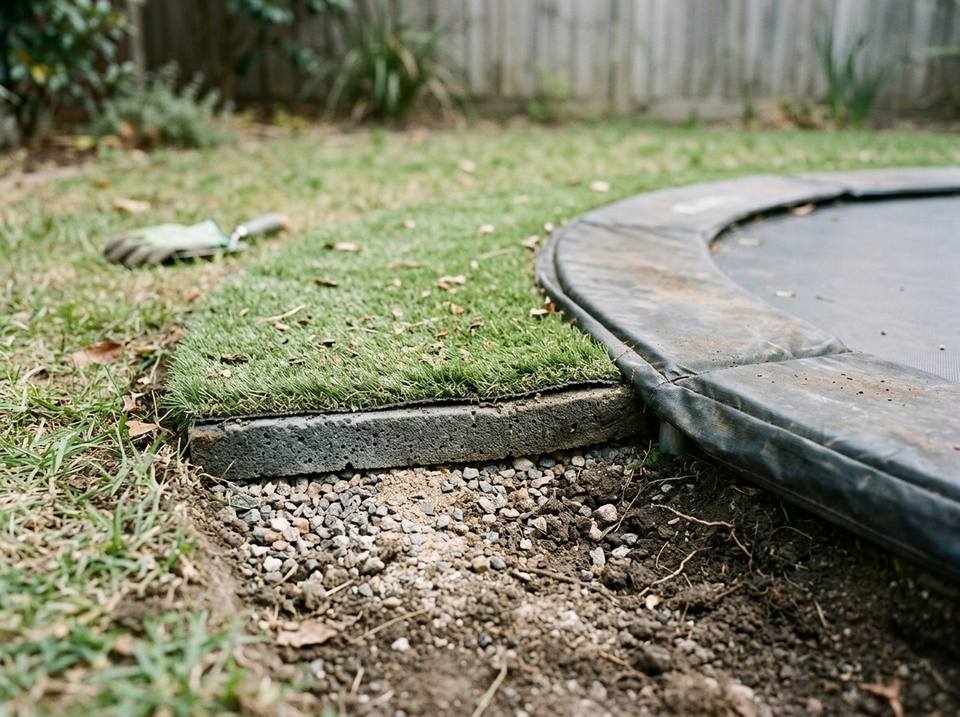
The dangerous fall from a trampoline isn't onto the mat. It's off the side, onto the ground.
That's why Berg recommends turf over an impact-absorbing base around the trampoline. A foam shock pad under the turf ring cushions a child who bounces off the edge. Lay the pad as a ring around the frame, then turf over the whole area so it looks seamless. Under the mat itself, you can skip the pad.
This isn't a single product to buy. It's a setup. Look for a pad whose maker states its impact rating, and use turf like #1 or #2 on top. A rated pad cushions; a generic foam roll may not.
Skip it only if your trampoline has a full safety enclosure and the ring is out of reach. Even then, a pad adds comfort.
Our take: from laying turf over padding for stages and play floors, the join between padded and unpadded areas is where a lip forms, so we'd turf over the whole area in one layer to keep the surface flat. A pad reduces impact; it doesn't make falls safe, so follow your trampoline maker's guidance too.
Shock pad guide · Faux grass padding
4. Petgrow Deluxe + Pad — Best Faux Grass for In-Ground Trampolines
Pile: 1.38 in | Face weight: 70 oz (seller-listed) | Fiber: PE + PP
In-ground trampolines sit level with the lawn, so the turf surround gets jumped onto all the time.
That's where density matters. Petgrow Deluxe lists a 70 oz face weight at 1.38 in. Dense blades hold up to kids landing and running on the surround, and the PE in the blend keeps it soft on knees. Over a foam pad, the surround becomes a soft, level landing ring that runs right up to the trampoline's edge. Bob Vila named this line its best value turf.
But it comes in pieces like 3.3 × 5 ft, so a ring needs several pieces and careful seams. Lifted seams trip bouncing kids, so tape and nail them flat.
Skip it for above-ground trampolines. Go to #1.
Our take: from our work with artificial grass, seams are the weak point on any multi-piece install; with dense turf like this, brushing the blades over a well-taped seam hides it, but a rushed seam shows and lifts.
Check price on Amazon · Read our Petgrow review
5. VEVOR 12 × 7 ft, Two Pieces — Best Budget Faux Grass for Under a Trampoline
Pile: 0.6 in | Fiber: polypropylene | Size: 12 × 7 ft each
Just want the dead circle gone, cheaply? Two pieces do it.
VEVOR's 12 × 7 ft pieces join side by side to make a 12 × 14 ft square, enough to cut a circle for an 8 or 10 ft trampoline. The 0.6 in pile is short and easy to keep clean under the mat, where leaves and grit collect. Drain holes let rain through.
But two pieces mean a seam, so put it under the mat, not across the landing ring.
Skip it for the landing area. Go to #3.
Our take: short polypropylene turf is the practical budget choice for a shaded spot nobody lands on; in our experience it sheds leaves and grit easily, though it feels stiffer and looks less natural than PE.
Check price on Amazon · Seam tape guide
How do you lay turf under an in-ground trampoline?
In-ground trampolines need drainage first, then a padded turf surround. Here's the order:
- Dig the pit with drainage. The pit under an in-ground trampoline collects rain. It needs a gravel soakaway or a drain, or it fills like a pond.
- Build the retaining wall. The pit sides need a retaining wall so the soil doesn't collapse under the frame.
- Level and compact the surround. Build a firm, flat base around the pit edge. See our installation guide.
- Lay a pad ring. Lay a foam shock pad around the trampoline edge, where kids land.
- Turf right up to the frame. Cut turf to meet the trampoline's edge cleanly, and fix it so there's no lip.
- Check drainage after rain. If water pools in the pit, add more drainage. See faux grass for drainage.
Trampoline turf questions
These are the questions parents ask most.
Does turf under a trampoline get hot? The part under the mat stays shaded, so it stays cooler. The ring around it gets full sun and heats up like any turf. Test it with your hand before barefoot jumping on hot days.
How do you anchor a trampoline on turf? Use the trampoline's ground anchors through the turf. Cut a small slit or use a sleeve where each anchor goes in, so the turf lies flat around it. Re-check anchors after storms.
Want more play-area turf? See faux grass for kids, or go back to the best faux grass.