5 Best Faux Grass Picks for Garden Paths (2026): Turf That Frames Stepping Stones and Walkways
As an Amazon Associate we earn from qualifying purchases.
Faux grass makes a garden path that never wears a muddy line, whether it is a strip of turf or the green between stepping stones.
Every garden has a desire line. It's the route everyone actually walks, from the back door to the shed or across to the vegetable beds. On a real lawn, that line turns bare and muddy by spring. Turf ends that, and it frames stepping stones far more neatly than grass you have to trim around with scissors.
So these picks are matched to path styles. We compared seller-listed specs on Amazon and read buyer review patterns, plus stone-path guidance from Bob Vila.
Turfing between beds rather than along a path? See faux grass for gardens. For geometric looks, see checkerboard faux grass.
Quick picks: the best faux grass for garden paths
| Path style | Pick | The spec that decides it |
|---|---|---|
| Stepping stones set in turf | Goasis Lawn Premium | 1.38 in pile with thatch hides cut edges |
| Turf walkway strip | LITA Realistic Deluxe | Bob Vila's high-traffic pick |
| Turf between pavers | Grassline Solutions 2 in × 25 ft | Pre-cut 2 in strips |
| DIY tile path | VANCASTLE Interlocking Tiles | Clip-together tiles, no digging |
| Best budget | Moxie Direct | Long roll for a long path |
Which path style suits your garden?
Four path styles cover most gardens:
| Style | Look | Feel | Best for |
|---|---|---|---|
| Full turf strip | Soft green walkway | Soft underfoot | Casual cottage gardens |
| Stepping stones in turf | Stones floating in lawn | Firm stone steps | Most gardens, the classic look |
| Turf between pavers | Geometric grid | Firm pavers | Modern gardens, patios |
| Turf tiles and plastic pavers | Modular, removable | Firm | Renters, DIY, quick installs |
A full turf strip is the softest option, but the middle of the strip takes every footstep, so it can flatten over time.
Stepping stones in turf put your feet on stone and use turf to fill the gaps. That spreads the wear and looks like a garden path should.
Meanwhile, turf between pavers gives a clean, modern grid. Feet land on paving, and the turf lines stay neat because nobody steps on them much.
Tiles and plastic pavers clip together on a flat surface with no digging. They suit renters and quick projects.
More layouts are in our faux grass ideas guide.
The 5 best faux grass picks for garden paths
These five picks suit the most common garden paths.
1. Goasis Lawn Premium — Best Faux Grass for Stepping-Stone Paths
Pile: 1.38 in | Colour: 4-tone with thatch | Backing: slip-resistant with drainage
A stepping-stone path means cutting turf around every stone. The turf you choose decides whether those cuts show.
Goasis has a 1.38 in pile with a brown thatch layer. Taller blades lean over the cut edge and soften it, so each stone looks set into a lawn rather than dropped onto a mat. The thatch fills the base around each cut, hiding the backing. Bob Vila named Goasis its most realistic turf, which matters on a path you look down at every day.
But Goasis rolls ship folded, and buyers report creases that take days to relax. Let the roll flatten fully before you start cutting around stones, or the cuts won't line up. See our wrinkles guide.
Skip it if your path is a full turf strip with heavy daily traffic. Go to #2.
Our take: from our hands-on work with artificial grass, a taller pile with a brown thatch is the most forgiving turf to cut around curves; short, thatch-free turf shows every knife mark and gap at the edge.
Check price on Amazon · Read our Goasis Lawn review
2. LITA Realistic Deluxe — Most Durable Faux Grass for a Walkway Strip
Pile: 0.8 in | Fiber: UV-resistant PE + PP (seller-listed) | Colour: 4-tone with thatch
If your path is turf all the way, you need turf that won't wear a flat line down the middle.
Bob Vila picked LITA as its high-traffic turf, and its 0.8 in pile is why. Short blades have less length to fold over under feet, so they recover faster than tall lawn turf. The four tones and thatch still look like a real lawn path. LITA also lists UV-resistant yarn, which matters for a path in full sun.
But short pile looks a little flatter than a plush lawn, and buyers report flattening on the very busiest routes over time. Brush the path monthly to lift the blades.
Skip it if you'll have stepping stones. A taller pile hides cuts better. Go to #1.
Our take: in our experience handling turf, a short, dense pile is what keeps its shape where feet land again and again; tall, plush blades lay flat along a walked line much sooner.
Check price on Amazon · Read our LITA review
3. Grassline Solutions 2 in × 25 ft — Best Faux Grass Between Pavers
Size: 2 in × 25 ft strip | Pile: 1 in | Colour: lime / olive
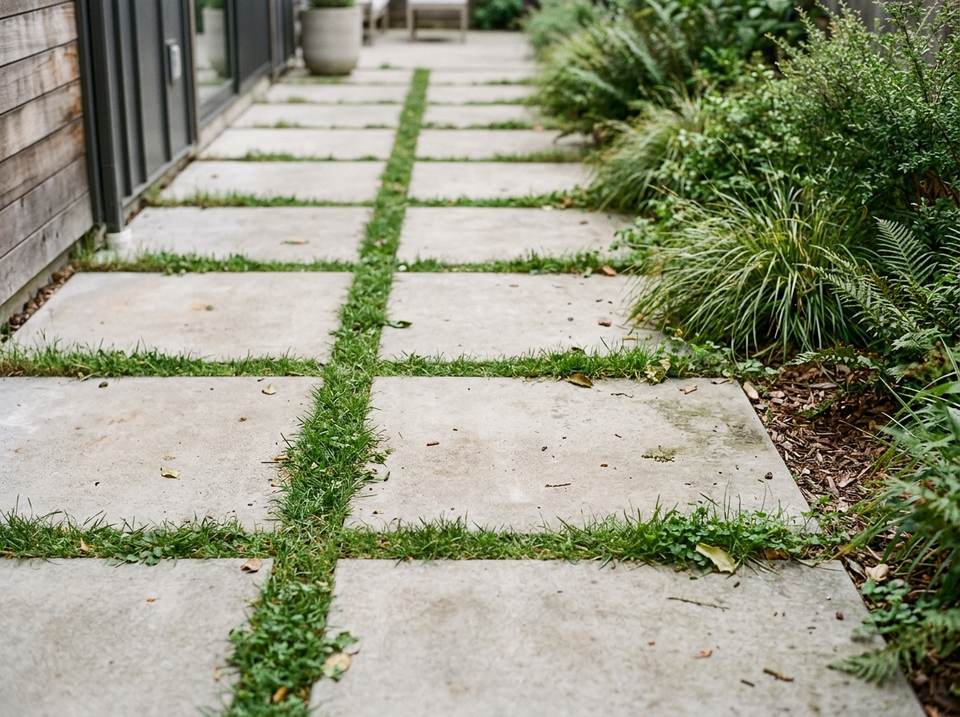
A paver path with green lines between the slabs looks sharp. Cutting those thin strips by hand is the hard part.
Grassline Solutions sells turf pre-cut into 2 in wide strips, 25 ft long. Drop them into the gaps between pavers, and the lines stay straight and even, with none of the wobble you get cutting strips from a wide roll. The 1 in pile sits a touch above the pavers, which is the look you want. The two-tone lime and olive colour suits a modern design.
It also only fits gaps about 2 in wide. For wider gaps, cut strips from a roll like #2.
Skip it if your gaps are wider or uneven. Go to #2.
Our take: from our hands-on décor work, thin turf strips cut by hand rarely stay perfectly even, so pre-cut strips are the easier way to get crisp green lines that look deliberate.
Check price on Amazon · Faux grass vs pavers
4. VANCASTLE Interlocking Tiles — Best DIY Tile Path
Size: 12 × 12 in tiles, 9 per pack (9 sq ft) | Fiber: PE | Base: self-draining click-lock
Want a path down by this afternoon, with no digging and no knife? Lay tiles.
VANCASTLE's grass tiles clip together on a flat, hard surface, like an existing concrete path or patio. Alternate them with matching-size plastic or stone pavers for a checkerboard path. The raised base drains underneath, so rain doesn't sit on the path. And if you move, the whole path packs up.
The blades are polyethylene, so they're soft to step on barefoot.
But tiles need a flat, hard base. They don't sit well on soil. A few buyers also report tiles that won't stay clipped on uneven surfaces.
Skip it if your path runs over a soil lawn. Go to #1.
Our take: from our work with artificial grass, clip-together tiles are quick and tidy on a hard, level surface, but the tile seams show more on a long run, so they look best broken up with pavers.
Check price on Amazon · Read our VANCASTLE review
5. Moxie Direct — Best Budget Faux Grass for a Long Path
Pile: 0.4 in | Fiber: polypropylene | Backing: rubber with drain holes | Size: up to 8 × 65 ft
A long side path, from the front gate to the back garden, eats turf. Moxie covers it cheaply.
Its biggest roll is 8 × 65 ft. Cut it lengthwise into narrower strips, and one roll makes a very long path with no cross seams. Moxie says it cuts without fraying. The short 0.4 in pile is firm underfoot and easy to sweep.
But at 0.4 in, it looks more like a green carpet than a lawn path. Polypropylene also fades and wears faster than PE turf.
Skip it for a showpiece path. Go to #1.
Our take: in our experience, short polypropylene turf is fine for a practical side path, but it reads as carpet up close and loses its colour faster in full sun than PE turf does.
How do you lay faux grass around stepping stones?
Set the stones first, then cut the turf around them. Here's how:
- Space the stones to your stride. Bob Vila's path guidance is to space stones to a comfortable step. Walk the path normally and mark where the centre of each foot lands. That's where each stone goes.
- Dig and set each stone level. Dig out the base area, add sand under each stone, and set it level and firm. Stones should sit flush with, or slightly above, the finished turf.
- Build and compact the base around them. Fill around the stones with crushed rock and compact it firm. A plate compactor works between widely spaced stones. See our plate compactor guide.
- Lay the turf over the whole path. Roll it out over the stones, and let it relax in the sun.
- Cut around each stone. Feel for the stone's edge through the turf, then cut from the back with a sharp knife in short strokes. See our cutting guide.
- Fix the edges. Staple or nail turf edges close to each stone so they can't lift and trip anyone.
- Add light sand infill. Brush a thin layer in to weigh the turf down and help blades stand up.
Path turf questions
These are the path questions gardeners ask most.
Does a turf path get slippery? Usually less than wet stone or mossy grass. Moss can grow on shaded turf, though, and that can be slick. Brush and clear debris regularly.
How do you stop a path wearing in the middle? Use stepping stones or pavers, so feet land on stone instead of turf. On a full turf strip, choose a short, dense pile and brush it often. See faux grass for high-traffic areas.
Does it drain over concrete? Only if the concrete drains. A Houzz forum discussion raised drainage and ventilation as the main concerns with turf over a concrete path. Make sure the slab slopes, or use raised tiles. See faux grass for concrete.
Want more garden turf? See faux grass for gardens, or go back to the best faux grass.