How to Cut Faux Grass Cleanly (2026): Tools, Straight Cuts, Curves and Seams
As an Amazon Associate we earn from qualifying purchases.
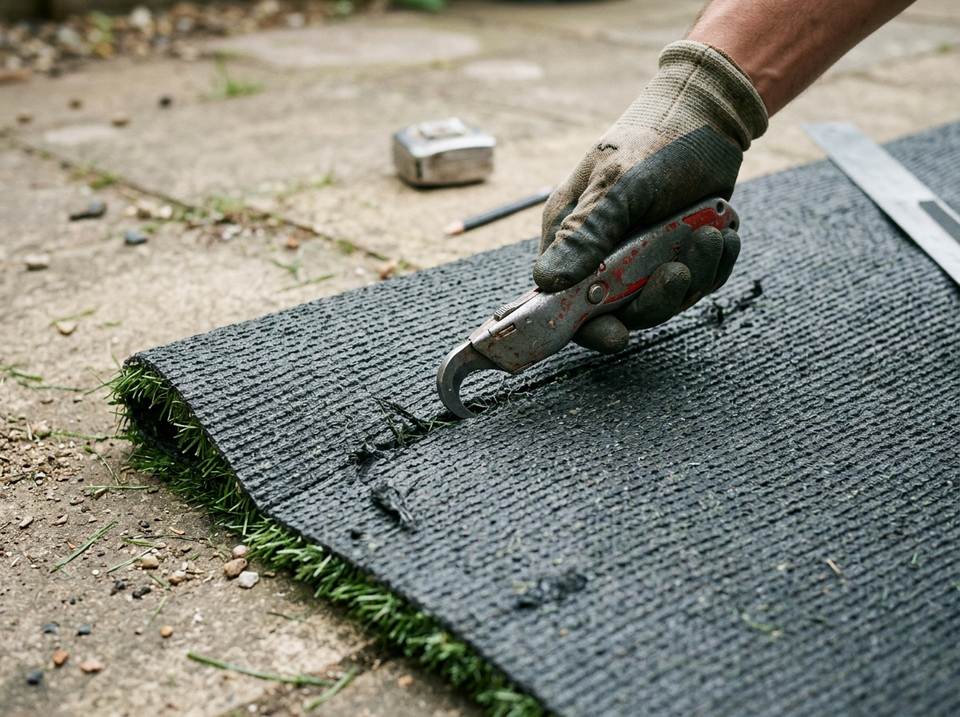
The secret to a clean faux grass cut is simple: cut from the back, with a fresh blade, a little at a time.
Cutting faux grass means slicing through the backing from underneath with a sharp blade, so the blades stay full and the edges stay straight. Cut from the top and you chop through blades, leaving a bald, ragged line. Cut with a blunt blade and the knife drags and tears the backing. Get it right and edges, curves and seams look factory-made.
This guide covers the tools, five golden rules, straight cuts, curves and seam cuts. We drew on cutting guidance from turf maker CCGrass, RealTurf and installer NexGen Lawns. Wear gloves, and change blades often.
What tools do you need to cut faux grass?
A utility knife does most of the work; a hook blade and shears handle the rest. Here's the kit:
- Utility knife with plenty of fresh blades. For straight cuts from the back.
- Hook blades or a hook-blade carpet knife. A hook blade pulls through the backing without catching blades. It's a common recommendation for turf.
- Heavy-duty carpet shears. For trimming small bits, tufts and edges.
- Chalk line and marker. For marking straight lines on the backing.
- Straightedge. A long metal ruler or board to guide straight cuts.
- Compass or string. For marking curves.
- Gloves. Turf backing and blades are tough, and knives slip.
What is the best tool to cut artificial grass? A sharp utility knife for most cuts, with hook blades for long runs and shears for trimming. Dedicated turf cutters exist, but the ones we found on Amazon drew mixed buyer feedback.
Auto Reload Utility Knife with 10 SK5 Blades — Best Knife for Turf
Type: retractable utility knife | Blades: 10 preloaded SK5 blades | Grip: non-slip rubber handle

Turf blunts blades fast, so a knife that reloads quickly saves a lot of fiddling.
This knife holds 10 SK5 blades preloaded inside the handle, so you can swap to a fresh edge in seconds. That matters on turf, where RealTurf warns that dull or rusty blades cut poorly. The rubber handle helps grip when you're pressing through thick backing.
But 10 blades won't last a full lawn. Buy spares.
Our take: from cutting a lot of artificial grass for event stages, a fresh edge is everything; turf backing dulls a blade within a few long cuts, and a knife you can reload in seconds keeps edges clean instead of frayed.
Bonsicoky Hook Blades, 50-Pack — Best Blades for Long Cuts
Type: utility hook blades | Pack: 50
A hook blade cuts by pulling, which keeps it on the backing and away from the blades.
Bonsicoky's 50-pack of steel hook blades fits standard utility knives, so you can switch between a straight blade and a hook in the same handle. The hook is ideal for long straight runs and trimming factory edges. Fifty blades means you can change them as often as you need.
But check they fit your knife before buying. Most standard utility knives take them, but not all.
Our take: in our hands-on turf work, a hook blade is the easiest way to run a long straight cut from the back without nicking the blades on the front, especially on thicker pile.
C.JET TOOL 10 in Heavy-Duty Carpet Shears — Best Shears for Trimming
Length: 10 in | Blades: stainless steel | Grip: soft

Some cuts are easier with scissors: tufts, tight corners and trimming around posts.
C.JET's 10 in shears are made for carpet and tough materials. They handle turf backing and stray blades easily, and the soft grip helps on long trimming jobs. They are a well-proven choice for this kind of job.
But shears are for trimming, not long cuts. Use a knife and straightedge for straight edges.
Our take: from shaping artificial grass around arches and props, heavy shears are what tidy the stray tufts a knife leaves behind; ordinary scissors bend and chew the backing instead.
The golden rules
Five rules prevent nearly every bad cut:
- Cut from the backing side. CCGrass recommends cutting from the back. You cut the backing, not the blades, and the edge stays full.
- Cut along the stitch rows. NexGen Lawns advises following the rows. Cutting between them keeps whole tufts on both sides.
- Cut slightly large, then trim. Leave extra at first, then trim gradually to fit. You can't add turf back.
- Replace blades often. RealTurf warns that dull or rusty blades cut poorly and tear the backing. Change them every few cuts on a big job.
- Let the turf relax first. Unroll turf and let it lie in the sun before cutting. Turf that's still curled from the roll shrinks or shifts after you cut it.
How do you cut straight edges and curves?
Straight cuts happen on the back; curves happen in place.
Straight cuts
- Flip the turf over. Work on the backing.
- Snap a chalk line. Mark the cut line, following a stitch row where possible.
- Lay a straightedge. Hold it firmly along the line.
- Cut in one smooth pass. Run a fresh blade along the straightedge. Don't saw back and forth.
Curves and obstacles
- Lay the turf in place, with extra. RealTurf advises leaving extra around curves.
- Make relief cuts. Around a tree, post or tight curve, cut small slits in from the edge toward the obstacle, so the turf can lie flat.
- Use the object as a guide. Run the blade tip against the edge of the path, bed or post.
- Leave a small gap. CCGrass suggests about 1/8 in around fixed objects, so the turf isn't forced against them.
- Trim a little at a time. NexGen Lawns recommends trimming gradually until the fit is right.
How do you cut artificial grass around curves and trees? Lay it in place with extra, make small relief cuts toward the obstacle, then trim gradually, leaving a small gap. For turf around trees, see faux grass for shaded areas. For beds, see faux grass for gardens.
How do you cut edges for a seam?
Trim off the factory edge before joining two pieces. Here's how:
- Find the factory edge. It's the outer few stitch rows along the long side of a roll, often spaced differently from the rest.
- Trim two or three rows. Cut along a stitch row from the back, removing the factory edge from both pieces.
- Cut both pieces the same way. Both edges should be cut along a row, so the gap between them matches the gap between rows.
- Test the fit. Lay the edges side by side. The join should look like just another row of stitches.
Then tape and glue the seam. See our seam tape guide and the full installation guide.