How Faux Grass Drains (2026): Backing, Base, Real Drain Rates and How to Fix Puddles
Faux grass drains in two stages: through the backing, then through the base, and the slower of the two sets the speed.
Faux grass drains through holes or a permeable backing into a porous stone base. From there, water soaks into the soil or flows to a drain. When it works, a lawn is dry minutes after a storm. When it doesn't, you get puddles, soggy patches and, with dogs, smell. Almost always, the cause is below the turf, not in it.
So this guide explains the drainage path, what drain rates mean, what slows drainage and how to fix puddles. We drew on turf brand and retailer guidance from RealTurf, Synthetic Grass Warehouse (SGW), Greatmats and TigerTurf. Most published drain rates are manufacturer figures, so we label them that way. For product picks, see faux grass for drainage.
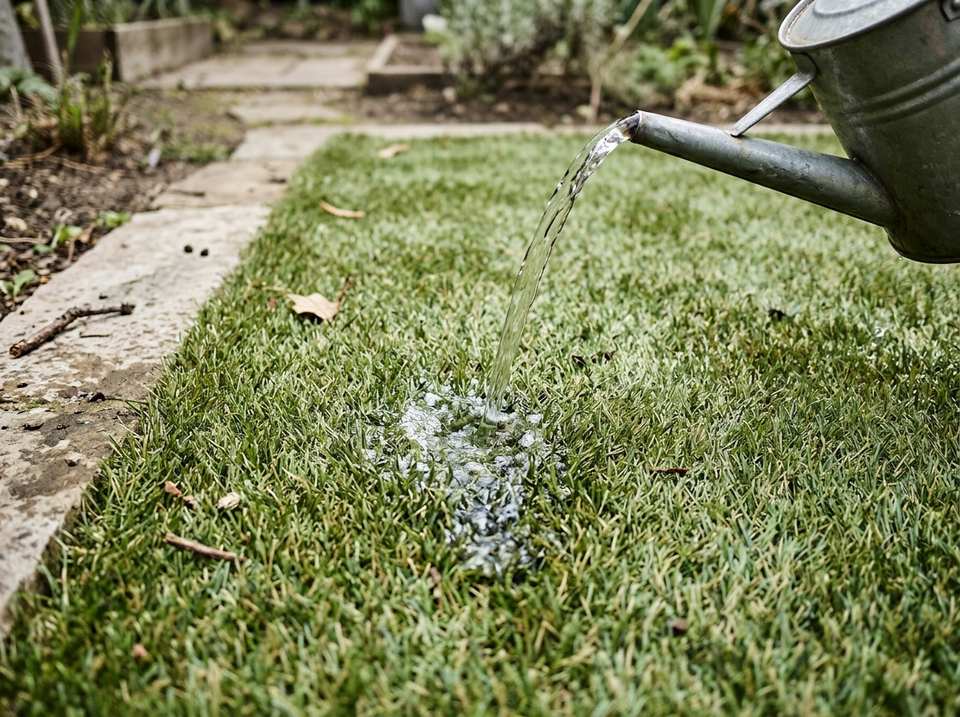
How does water drain through faux grass?
Water passes through the backing, soaks into the base and moves into the ground.
   Rain or urine
        ↓
┌───────────────────────────┐
│ Turf blades and infill     │  water runs down between the blades
├───────────────────────────┤
│ Backing (holes or porous)  │  water passes through the backing
├───────────────────────────┤
│ Compacted stone base       │  water spreads and drains through the rock
├───────────────────────────┤
│ Native soil or drain pipe  │  water soaks away or is carried off
└───────────────────────────┘
There are two main kinds of backing. Hole-punched backing has small drainage holes punched through it at regular spacing. Flow-through backing is porous across its whole surface, so water passes everywhere, not just at the holes. Inventors have patented non-perforated porous backings on that idea, which shows how much effort has gone into faster-draining turf.
Does artificial grass drain? Yes. All outdoor lawn turf is designed to let water through.
Where does the water go? Into the stone base, then into the soil below. On clay, concrete or rooftops, where water can't soak away, it needs a slope or a drain to carry it off.
So the key point is simple: turf drains only as fast as its base. A fast backing over a clay base still floods.
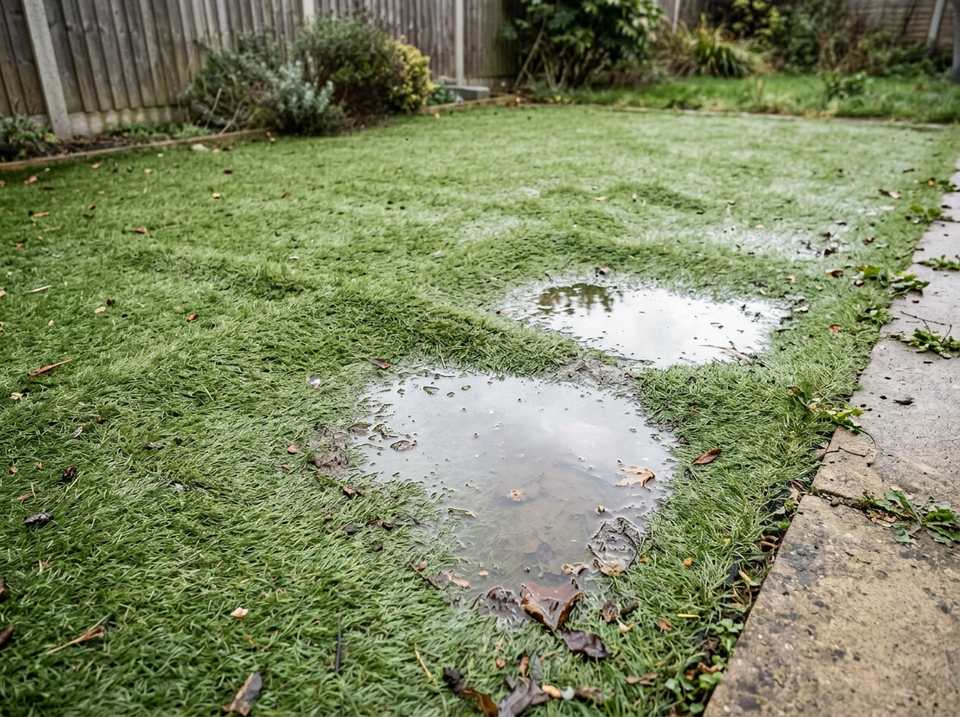
What do drain rates mean?
Even a basic hole-punched backing drains far faster than rain falls.
| Surface | Drain rate | Source |
|---|---|---|
| Hole-punched turf backing | About 30 in per hour or more | SGW and RealTurf (manufacturer claims) |
| Flow-through turf backing | 400 in per hour or more | SGW (manufacturer claim) |
| Natural grass lawn | About 5 to 20 in per hour | RealTurf (manufacturer claim) |
| Very heavy rainfall | A few inches per hour at most in typical storms | Weather records |
To put that in context, the world record for short, intense rain is about 12 in in 42 minutes, at Holt, Missouri, in 1947. That's around 17 in per hour, and it's an extreme record. Ordinary heavy storms bring a fraction of that.
So even basic hole-punched backing, at 30 in per hour, can take rain faster than it falls. The backing rarely limits drainage. The base and the soil underneath usually do.
How fast does artificial grass drain? Through the backing, much faster than rain falls. In practice, a lawn drains as fast as its base allows.
Is turf faster than real grass? By the manufacturers' figures, yes, at least through the backing. But treat those as vendor claims. A real lawn on sandy soil can drain well, and turf on a compacted clay base can drain badly.
What slows faux grass drainage?
Six problems cause almost every slow-draining lawn:
- A compacted or clay base. If the base is too fine, too compacted or sits on clay, water has nowhere to go. This is the most common cause.
- No slope. A perfectly flat base holds water. A gentle fall lets it run off. See our base guide.
- Clogged drain holes. Dirt, dust, pet hair and leaf debris can block holes over time.
- Matted fibres and compacted infill. Flattened blades and packed infill slow water on the surface.
- A solid backing. Some indoor or rug-style turf has no holes at all. Outdoors, it can't drain.
- Runoff from elsewhere. Water from a roof, a patio or a neighbour's yard can flood a lawn faster than any base drains. TigerTurf notes that runoff needs planning.
Why is my artificial grass not draining? Start with the surface: clogged holes and matted infill are the easy fixes. If water still pools, the problem is the base or the slope.
How do you fix puddles on faux grass?
Start with the easy fixes on the surface before lifting any turf. Work through these in order:
- Clear debris. Blow or brush off leaves, dirt and pet hair. Debris on the surface blocks drain holes.
- Power broom the lawn. Brushing against the grain lifts matted blades and loosens compacted infill. See our power broom guide.
- Flush the infill. Hose the area hard to wash fine dirt down through the turf. On zeolite infill, skip constant flushing.
- Check the backing. If the turf has a solid backing or very few holes, punch extra drainage holes with an awl or a hole punch, spaced a few inches apart.
- Regrade low spots. If water always pools in one dip, the base has sunk there. Lift the turf at the nearest seam or edge, add base material, compact it, and relay the turf. See our repair guide.
- Add a drain. On clay or flat sites, a French drain, a gravel trench with a perforated pipe, can carry water away. This is usually a job for a landscaper.
In practice, most puddles clear at step 1, 2 or 3. If you get to step 5 or 6, the base was likely built too thin, too flat or on poorly draining soil.
Our take: from our hands-on work with artificial grass, matted blades are the drainage problem people miss. Turf that's been walked flat stays dark and damp-looking long after the base has dried, and a firm brush against the grain usually fixes both the look and the flow.
Drainage questions
These are the drainage questions owners ask most.
Does turf drain on concrete? Only as fast as water can run off the concrete. Concrete doesn't absorb, so the slab needs a slope, and you may need drainage tiles or a pad under the turf. See faux grass on concrete.
Does pet urine drain the same way? Yes, it follows the same path, but urine leaves residue that water alone doesn't remove. A fast-draining backing and base, plus regular rinsing and an enzyme cleaner, keep smell down. See faux grass for drainage and pets.
How do you test drainage? Run a hose on one spot for a few minutes and watch. Water should disappear into the turf rather than spreading and pooling. Test a few spots, including any low areas.
And for wet climates, see faux grass for heavy rain.